

Prabhav Daily: Hari Sharan Subedi – Striving through Struggle & Persistence
Published in the “Prabhav National Daily” February 9, 2023

Subedi to CorporateKhabar: TV industry has lots of possibilities!
“A.D. Release and Hari Sharan Subedi” published in the CorporateKhabar Business Magazine, Falgun 2079 BS issue

Subedi to AnnapurnaExpress: Market Saturated with TV Stations
Hari Sharan Subedi: Market saturated with TV stations

Hari Sharan Subedi is the Managing Director of A.D Release, one of Nepal’s leading media buying agencies. With over 20 years of experience in the Nepali media and advertising industry, Subedi has played a pivotal role to introduce pioneering program concepts into the Nepali television industry that include reality TV shows such as Nepal Idol, The Voice and SaReGaMaPa Li’l Champs Nepal along with full production and marketing of the Super Dancer Nepal.
Subedi and his team have also introduced Nepal’s local reality shows such as Comedy Champion and the popular comic series Sakkigoni.
Subedi has been at the forefront of changing the television media sales landscape via innovative advertising segments including on-screen advertising and sponsored segments across news and programs. He is currently the Executive Member of the Advertising Association of Nepal (AAN) and a member of the Information and Communication Technology Development Sub-Committee of the Federation of Nepalese Chambers of Commerce and Industry (FNCCI). The Annapurna Express caught up with Subedi to talk about media buying and the Nepali television industry, Excerpts:
Your agency has consistently been at the forefront of television advertising in Nepal. How would you introduce your business and the industry you are in?
We are a team of think-alike people, and it has been a collective achievement so far. The Nepali television industry has come a long way as the industry grew manifold, thanks to investment in news and programming as well as technology. Today, the television industry employs over 3,000 people, ranging from journalists to production, engineering, administrative and marketing professionals.
The main source of revenue is advertisements. And, the whole advertisement segment has also evolved remarkably in these years. We have seen the whole transition, from VHF tapes to DV tapes and now to transferring audiovisuals digitally across various TV stations from your own office. As a media buying agency, we take pride that we also contributed to this transition positively which helped the overall industry to expand.
Of late, with the growing number of TV channels, there is also the issue of sustainability that is being increasingly discussed within the TV industry. As TV channels fight for advertising revenue that has not grown, do you think these channels will survive?
We have seen flooding of TV stations, from satellite TV stations to regional TVs and those promoted by TV channel distributors in recent times.
Around 200 satellite TV stations have taken licenses, of which over 60 are currently in operation. Even when operated in a very minimalistic manner, the combined operating cost of these channels would be approximately Rs 3 billion. However, the size of the advertising market has fallen post-Covid, and even further due to the current economic slowdown to around Rs 2 billion. How can advertising sustain the television industry in this scenario?
On the other hand, there is a lack of investment in content and broadcast quality. For any TV to have a huge following, one needs to have programs that are attractive, and intriguing for the viewers. Instead, what we see is that most TV stations have the same kind of programming. And, there is also a serious dearth of specialization.
Internationally, sports channels are the most expensive to subscribe to. The world has realized that live sports generate the highest viewership. Unfortunately, we are going one step further in Nepal, killing the exclusivity of TV broadcasts by coupling it with the concurrent digital broadcast.
Reality shows, series, sports, and everything are available on YouTube, and this is the main reason behind the falling TV subscriptions. And to add to this is the Clean Feed debacle. International channels were supposed to be free of advertisement, but we have to see the same irritating promotional spot repeatedly. TV watching has become unpleasant with average content, subscriptions have fallen, and with the economic slowdown, it is natural that advertising revenues have also declined.
What are the pressing issues plaguing the TV industry? Why is the Nepali advertisement market not able to sustain the growing number of TV stations?
Despite the economic slowdown, the number of new media outlets is growing. The situation is such, every advertiser faces a huge dilemma today. While the advertiser’s advertising budget has not grown, they are getting increased follow-up from the media marketers.
Rather than advertising on the media platform that suits their target group, advertisers are literally forced to balance the media, particularly the smaller media outlets that resort to unfair practices. I am personally aware of some larger advertisers forced to distribute ads proportionately across larger to smaller media.
Everyone wants to run a news channel – every TV, every online portal, and every YouTuber. And then there is an absence of television and media rating mechanisms. In India, the TRAI, the government body, rates media by their reach and popularity or following. There is no such mechanism in place in Nepal.
The economic downturn has impacted all businesses across Nepal. But you say that a ‘lack of regulation’ is hurting television media. Are you hinting that there is a lack of regulation across the media sector of Nepal?
Yes. If we look at the huge investments made by satellite TV stations in broadcast equipment, satellite and carriage charges, generating employment, licensing fees, royalties, and taxes, how is it fair for them to compete for viewership with one individual flashing a Go-Pro or cell phones and broadcasting live news on YouTube?
Globally, TV is still considered the most credible or trusted source of information. Major TV stations ensure the source or accuracy of news before broadcasting, or otherwise, they have to face complaints and a hit to their credibility.
While the developed world is out there battling fake news and taking Facebook and Twitter to court, we in Nepal, are allowing ‘one-man armies’ to broadcast news unabashedly. It is only fair that the government regulates online and social media before too much damage is done. If the TV industry falls, thousands of jobs, huge investments, and families will suffer.
Media owners also need to do their bit. They must lobby with the government to ensure appropriate regulation, and maintain the exclusivity of their content. They must stop immediate or concurrent digital broadcasts. Look at international practice—one may be able to enjoy a short clip of a program on digital platforms only after one to four weeks, but you will not find the entire program on YouTube.
Similarly, TV stations should not be marketing themselves based on YouTube or Facebook views, and content makers should stop developing content solely for digital platforms.
Don’t you think TV stations also need to upgrade their content and broadcast quality?
Not all TV stations are of low quality. TV stations such as Nepal TV, Kantipur HD, Himalaya HD, AP1 HD, and Galaxy 4K have spent millions on quality equipment, and are investing big in programs and reality shows.
Many TV channels have staff or stringers throughout the country. But not all TV stations have invested in broadcast equipment, human capital, and content quality. We could introduce some strong provisions to open a TV station, such as increasing the license fee and setting criteria for infrastructures.
Let there also be regulation for existing channels to ensure the quality of their broadcast standard. TV viewing would become more pleasant with better broadcast quality.
And, it is also the responsibility of TV channels to make people watch TV. There are sufficient examples in India, of how they dramatize series, news, and reality shows, adding intrigue to their presentation to ensure viewership. This was possible due to their separation of production and broadcasting. They outsource content production, while still retaining creative control. The very existence of production companies depends on the quality of their output.
Don’t you think there is also a lack of regulation on digital advertising in Nepal as well?
I am confident that the central bank has no data on the size of digital marketing in Nepal. At the outset, it would seem that advertisers are spending only some of their budget on digital advertising. But, a large number of small budgets adds up to a large outflow of forex. And does the country benefit from that spending? Traditional media would pay taxes on their earnings to the government. Does Google or Facebook pay taxes to the Nepal Government?
In addition to this, there is an issue with clean feed. Nepali TV channels are not supposed to play foreign or dubbed advertisements. But these very advertisements can be played on digital and outdoor media platforms. How is it fair? Why would advertisers then develop localized advertisements if they can do it on digital and outdoor media? They would simply change the medium of advertising, replacing TV with digital media. And then TV advertisements must be censored to ensure no misinformation. Digital platforms go uncensored, untaxed, and unregulated. It is high time the government took these matters seriously. Not doing anything means bidding farewell to the Nepali TV industry.
If the advertisement market cannot sustain the growing number of TV stations, how can we expect them to invest further in content and broadcast quality?
Under current circumstances, the market cannot sustain the growing number of TV stations. Look at the international practice where TV stations earn almost equally through advertising and subscriptions. Nepali households pay handsomely to watch foreign channels but want to watch Nepali channels for free, and then complain about content and broadcast quality, comparing them with Indian shows. Isn’t that hollow nationalism?
If Nepali TV channels give strong content backed by the international-level production quality, why would people need to watch foreign channels? But, for this to happen, Nepal must embrace the subscription model. This is not a new concept though, the industry has discussed this for over a decade, but has been unable to implement it due to differences between TV owners themselves and TV distribution companies. Should they embrace it, subscription revenue would pave the way for further investment in content quality, and the competition between TV stations would automatically filter out stations that don’t invest in quality and content.
TV channels can price themselves based on demand, viewers are able to pick and choose the channels they are willing to pay for, and advertisers have a strong basis to select where to advertise.
Subedi to theHRMnepal: Subscription model needed in Nepal’s TV industry
Subscription model needs to be introduced in Nepal’s media industry
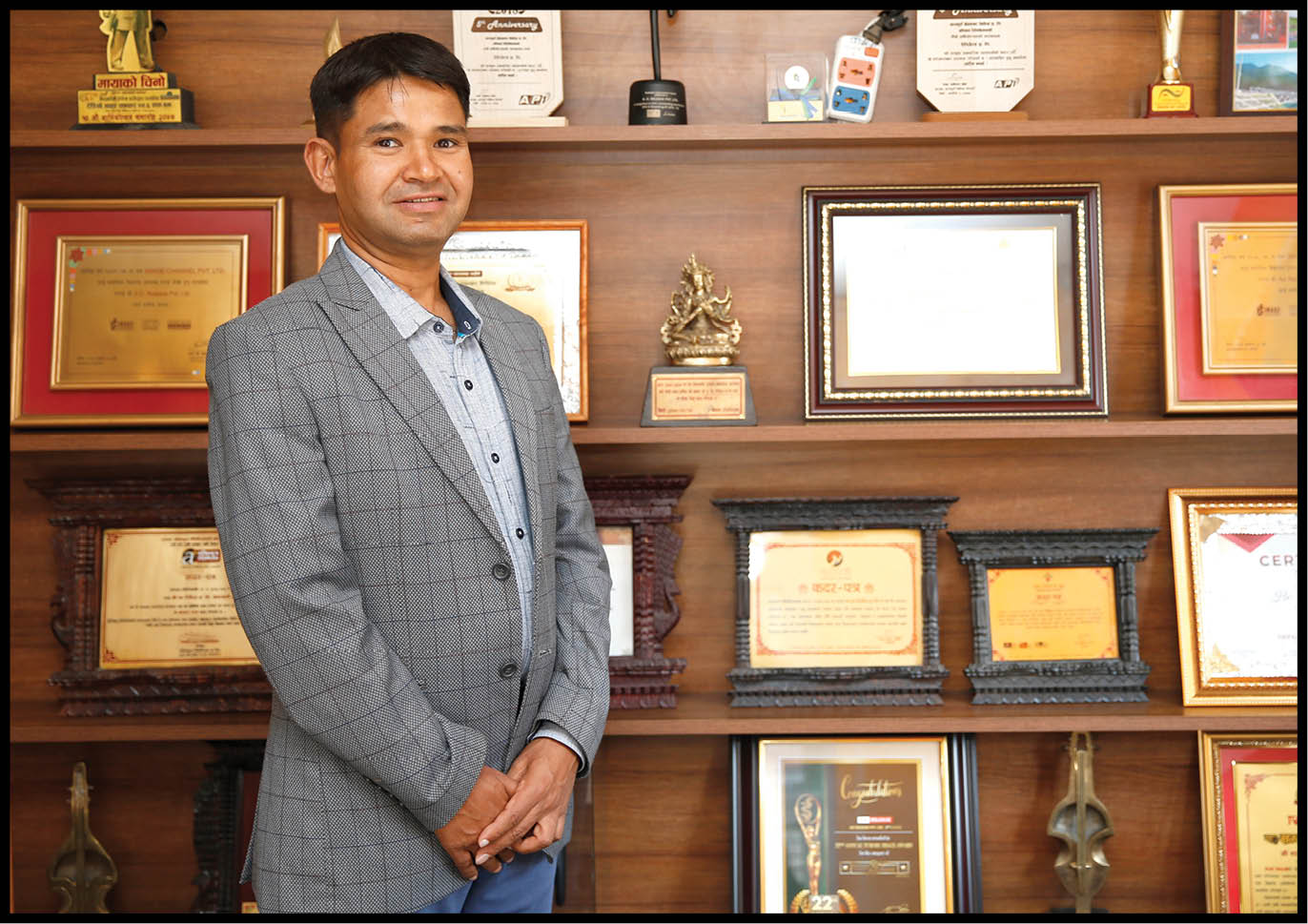
Hari Saran Subedi is the Managing Director of A.D Release, one of Nepal’s leading media buying agencies. With over 20 years of experience in the Nepali media and advertising industry, Subedi has played a pivotal role to introduce pioneering program concepts to the Nepali television industry that include reality TV shows such as Nepal Idol, The Voice and SaReGaMaPa Li’l Champs Nepal along with full production and marketing of the Super Dancer Nepal.
Subedi and his team have also introduced Nepal’s local reality shows such as Comedy Champion and the popular comedy series Sakkigoni.
Subedi has been at the forefront of changing the television media sales landscape via innovative advertising segments including on-screen advertising and sponsored segments across news and programs. He is currently the Executive Member of the Advertising Association of Nepal (AAN) and a member of the Information and Communication Technology Development Sub-Committee of the Federation of Nepalese Chambers of Commerce and Industry (FNCCI). the HRM caught up with Subedi to talk about media buying and the Nepali television industry. Excerpts:
With the country’s economy going through a recession, the media industry is under pressure with reduced spending on advertisements and promotions by advertisers. How do you assess the current scenario of the Nepali media industry, particularly the business side?
Till a few years ago, the Nepali media industry was growing well. However, the impacts of the Covid-19 pandemic, the Ukraine-Russia conflict, and rising prices have changed the scenario. The delayed impact of the pandemic on consumer purses, together with the rising cost of funds, has seriously dented purchasing capacities. Amid dwindling demand and a rise in costs of production, domestic industries are facing a downturn, so it is only natural that advertising budgets would fall steeply. So, media business is not as good as it used to be. The irony is that even as industries and trade face difficult times, the number of media is still rising. Even established media houses are finding it difficult to meet their costs of operation. But we are still hopeful that the media industry will bounce back with some political stability in place. However, the media industry’s sole dependence on advertising revenues will be a stumbling block to getting back to the levels of past years.
Given the revenue source model of the domestic media industry, how can the people in the industry think beyond the existing model for sustaining business? What could be the new revenue models?
Nepal’s media industry is completely dependent on advertising revenues, except perhaps print media which does recover some costs through sales. The advertising market, even when it was growing, was not able to sustain the rising number of media in Nepal. Take for example TV stations operating in Nepal; almost 200 channels are licensed, and around 60 satellite channels are operational. They have substantial costs of operation and huge investments in equipment and human resources. Even if each channel were run with very meager budgets, the annual cost of operations would be no less than 300 crores. Compare this to the current TV advertising industry size of fewer than 200 crores. And then we have regional TV channels, channels operated by distribution platforms, and then the unknown number of unregulated Facebook channels and YouTube channels.
Internationally, TV stations earn almost equally through advertising and subscription revenues. We don’t have to look beyond our closest neighbors to see this practice. Only state-run channels are “free” to watch. In Nepal, we pay handsomely to watch foreign channels, but want to watch Nepali channels for free, and then complain about the quality of broadcast and programs, comparing with Indian shows.
If domestic TV stations were to have better resources through subscription, they could produce and broadcast international quality programs with strong content, professional presentation, international-level lighting and setup. This is exactly what has happened in India! You will see very few international franchises shows operating in India; they have their own shows that are followed very well by the viewers.
Therefore, the subscription model needs to be introduced in Nepal’s media industry. This is not a new concept though. The TV industry has discussed this for over a decade but has been unable to implement it due to differences between TV owners themselves and TV distribution companies and a lack of foresight by the government. Should they embrace it, subscription revenue would pave the way for further investment in content quality, and the competition between TV stations would automatically filter out stations that don’t invest in quality and content.
Similarly, with print media, there has been a worldwide trend toward taking to the digital landscape and introducing a subscription model.
 Print media has been dominant in Nepal for a long time. However, it is losing its business as well as its prominence of late. How do you see the future of print media in Nepal?
It is true that print media was the most prominent till a few years ago. Even when bombarded with news from online portals and unregulated YouTube channels, people still trust reputed newspapers and TV channels. Printed news still has a lot of trustworthiness. Print media is still attractive to advertisers. You can’t beat the details you can provide through pages of newspapers or magazines with a few seconds of audiovisual ads.
The vacuum created by Nepal’s print media in not going digital soon enough coupled with the lack of regulation of online and digital platforms has led to uncountable “digital” channels that show sensational “fake” headlines with different news inside. Whereas traditional TV and print media are some of the most regulated in terms of censorship, these so-called channels are out there making fake claims without fear of action against them.
Regulations apart, Nepal’s print media has already embraced the digital platform. Now it’s about how strongly they can invest in their content and how well they can educate news consumers that their news is trustworthy and worth subscribing to.
Your agency has consistently been at the forefront of television advertising in Nepal. How would you introduce your business and the industry you are in?
We are a team of think-alike people, and it has been a collective achievement so far. The television industry of Nepal used to be a growing industry until very recently. From the first VHF broadcast of Nepal Television in 2041 BS to the launch of the first few private TV stations between 2058 BS and 2060 BS, to the launch of High Definition and even 4K quality TV stations, we’ve come a long way.
Currently, the television industry employs over 3,000 people from the journalism, production, engineering, administrative and marketing fields. The TV advertising sector has grown as well. From meeting Nepal TV’s timeline to speed deliver ad tapes to being able to share ads digitally across numerous TV stations, and having the ads play the way you planned creatively, the TV advertising sector has seen so many upturns in the last few decades.
A.D Release has been focused on investing in and marketing strong content across Nepali TV channels. Some of the programs we have presented have our involvement right from the franchise acquisition, while some others could be successful due to our major marketing push. Some international shows had a budget of over Rs 70 million, whereas some local shows had a Rs 50 million price tag. Thanks to our sponsors and their trust in our services, we have been able to contribute towards the development of Nepal’s TV industry.
Of late, with the growing number of TV channels, there is also the issue of sustainability that is being increasingly discussed within the TV industry. As TV channels compete for advertising revenue that has been reduced, do you think these channels will survive?
TV advertising revenues are currently way below operating costs. And still, we have new TV channels being introduced. This is neither normal nor sustainable. Setting up a TV station requires huge investments involving costs related to licensing, a whole lot of broadcast equipment, a bank of researchers and journalists, and a host of other regular costs like satellite and distribution charges. Have such investments been made following proper research? Doesn’t look like it, unless there are funds beyond advertising.
And then there are non-TV channels. We must take into account that the heavily invested and to an extent, well-regulated “traditional” TV stations must compete for viewership with one person flashing a go-pro or cell phone broadcasting live news on YouTube. Worldwide, “traditional” TV still retains a pole position as the most credible or trusted source of information. Reputed TV stations ensure the source or accuracy before broadcasting news, or otherwise face actions and a hit to their credibility. But the one-man news army doesn’t care about credibility, action, or consequences of misinformation, employing people, operating expenses, equipment investment, or taxes to the government. While the developed world is out there battling “fake news” and taking Facebook and Twitter to court, here we are allowing one-man armies to broadcast fake news unabashed.
These “sensational” channels may survive for as long as they are not regulated, and the YouTube income continues to flow in, but the heavily invested channels will not. They have many more families to feed, and a whole lot of expenses to bear.
What are the pressing issues in the TV industry currently? Why is the Nepali advertisement market not able to sustain the growing number of TV stations?
As I said earlier, operating a proper TV channel requires huge investments. Apart from the unsustainable number of channels we have, there are other issues as well. Take for example the programming; it’s almost similar across most of them, having 12 to 15 news bulletins, and a few talk shows. To compete for a piece of the advertising pie, each channel would have to have strong selling points. This would require investing in developing human resources, commissioning proper research, and having adequate setup and equipment. Without presentation or content setting you apart from others, and in the absence of TV viewership metrics, these channels compete with each other without a proper arsenal!
Internationally, there are bodies like the Broadcast Audience Research Council (BARC) which is commissioned by the Telecom Research Council of India, BARB, a non-profit commissioned by UK’s TV stations, advertisers and regulators and Nielsen (in the USA), which regularly measure the viewership of TV stations in their respective regions, thereby providing an objective way to develop advertising plans.
But that is not the case in Nepal. What we have instead is forced advertising. When a brand decides to advertise, there are over a dozen TV stations claiming to be the best! Add some political connections and coercive demands, and the advertisers would rather not advertise. They have started feeling more secure if they do not advertise at all, as when they advertise on one channel, there are others flocking to them, threatening them with so-called issues.
While differentiating your brand is one of the basic mantras in marketing, very few TV stations have tried to differentiate themselves. For example, sports channels are the most expensive to subscribe to internationally. Live sports generate the highest viewership and ad revenues globally. Unfortunately, in Nepal, we are killing the exclusivity of TV broadcasts by providing concurrent digital broadcasts of sports. Reality shows, series, and everything is available on YouTube, a prime reason for the falling TV subscriptions. Internationally, you would be able to see promotional clips and snippets of a show, but not the full show, unless you subscribe to the OTT app of that particular TV channel or group of channels.
And then there is the clean feed regulation for TV stations, which is not applicable for digital channels that are free-to-play international ads and dubbed ads, so why would an international brand develop a local ad and play it in Nepali channels? Furthermore, we have a “cleaned” feed instead of a “clean” feed. The ads in foreign channels are replaced with irritating promotional clips that take away your feel-good viewing experience. With the proper implementation of the clean feed policy, regulation of non-satellite channels, a practice of TV rating system, investments in content and differentiation, and exclusivity of TV shows, Nepal’s TV industry has boundless possibilities to grow.
The economic slowdown has affected businesses in almost all sectors. How is the broadcast advertising market facing challenges at present?
The advertising market is directly dependent on the growth of industrial and trade activities. So it is obvious to feel the pains of economic slowdown. Even established TV channels are finding it difficult to get by, seeing as much as a 50 percent reduction in ad revenues in some cases. How can this be corrected? I believe that even with the slowdown, broadcast advertising should have had a respectable volume, were it not for the lack of metrics.
Internationally, broadcast advertising is considered the most effective; for instance, a 2021 US survey put the perceived effectiveness of linear TV advertising at 55 percent while 46 percent said they were able to recall TV ads, as opposed to finding digital ads annoying! The global TV advertising industry is expected to grow by 6.3 percent despite the worldwide recession.
The government’s inability to regulate the advertising market is also cited as a factor affecting the growth of television media. What do you think should be regulated properly in this regard?
There needs to be equal regulation across all audiovisual platforms. Take for example the clean feed policy and general broadcasting norms affecting TV stations but not affecting digital channels. The commissioning of the Advertising Board is a step in the right direction, and the Advertising Association and agencies are lobbying with the board for improvements to their approach and what the board must focus on.
Instead of focusing on establishing the trading rate for advertisements, the board must steer towards longer-term projects such as categorizing all the media in Nepal based on their investment in equipment and human resources, their content and other appropriate bases. Coupled with establishing a viewership/readership metrics system, this would provide advertisers with a strong basis to develop objective and targeted media plans based on their brand’s needs, rather than forced and PR-based advertising.
Furthermore, the government also needs to realize that the dissemination of government ads and notices should not be only on state-run media. I am sure they are not stating that all other media are useless. The advertising caps on sectors such as banking and insurance must also be reconsidered.
How do you observe the quality of the contents of Nepali TV channels? What is lacking the most in this regard?
Most TV channels have the same type of content – presenting news similar to other TV channels in a similar fashion, about 15 times per day. This has been the practice for over 15 years, and the new TV stations are following the same suit. There is a lack of specialization.
But let’s not generalize it. There are a few TV stations that have taken huge risks and invested in high definition and even 4K broadcast equipment, better studio, highly paid anchors and mega reality shows. They have differentiated themselves and are expected to survive the current scare. Across other channels, there are many things lacking.
There is a lack of research to fuel their content, some of them are still using age-old equipment, and some others have only a handful of presenters and no other journalists for their 15 news bulletins, instead buying news from news agencies. So yes, there is a dire need for investment in content and broadcast quality across the sector.
It’s been over two and half years since the government implemented the Clean Feed Policy. How do you see this period for the Nepali advertising industry?
The Advertising Association brought up the need for clean feed over 20 years ago. So, we welcome the policy. However, the policy seems to have been hurried to ensure introduction within a particular party’s term in government, instead of a phased introduction. For clarity, the policy was “implemented” right before the first Covid-19 lockdown. Would foreign advertisers be able to develop ads locally during a lockdown period?
Even if the pandemic was unforeseen, the policy could have allowed dubbed ads to play in Nepali channels for some time even after foreign channels had stopped ads in their feeds. What this contributed to is a diversion of ad budgets towards digital platforms which the policy did not apply to, and towards distribution channel bonuses. We saw reputed brands spew out extensive digital campaigns in the absence of TV advertising. In a way, the advertising sector may have had the short-term benefit of extensive digital advertising budgets, but the longer-term impact of dollars leaving the country was overlooked.
Furthermore, with the “cleaned” feed across foreign channels, the viewing experience was affected by the irritating promotional clips, perhaps contributing to the fall in subscriptions. The key takeaway is that any regulation must be introduced with proper preparations, including monitoring mechanisms, and must be equal across all media platforms.
Have the objectives of the implementation of the policy been achieved?
I don’t think so. Of course, the policy is a step forward in the right direction. However, the policy was expected to grow the domestic advertising market. Local creativity and local artists for locally developed ads, the absence of other advertising platforms and thereby the need for international brands to advertise via Nepali media channels, and the resulting increase in advertising revenues and employment leading to more taxes to the government – none of these were achieved.
Although some of the blame can be attributed to the pandemic, the Russia-Ukraine war and the economic slowdown, we can still see room to improve the policy and its implementation. How about equal implementation across all media channels, and a “clean” feed instead of a “cleaned” feed? Furthermore, the global average spend on advertising is 6 to 8 percent of revenue. Has the policy secured this kind of spending by international brands in Nepal?
How do you observe the growth of digital media content? How do you see the prospects of such content replacing conventional content?
With time and technological advancements, the digital media movement is a worldwide phenomenon. Digital availability of content provides convenience to viewers, but the mushrooming growth without any regulation can be compared to the adage “too much sweet is bitter”. The consequences of misinformation apart, whereas traditional media generate employment and taxes, digital media do not. So, the government is not benefiting, the people are not benefiting, and as research data shows, more digital media users have reported being annoyed by ads than traditional media.
Add to this the stable credibility of traditional media, and the risk-averse approach of Nepal’s digital media channels. The primary truth is that people all over the world need localized content, the content they can relate to, which is possible only in Nepal for the Nepalis. So, the argument about whether platforms like TikTok can replace Nepali media is baseless. Apart from this, TV channels need to beware that providing their content free of cost on digital platforms is like axing the very branch you are sitting on. And advertisers also need to be wary that without traditional media such as TV and print, they are losing some of the most trusted mediums of advertising.
Rastrakhabar.com: Media businessman Subedi honoured by the Reporters Club
News covered by Rastrakhabar Online News Portal, 31 March 2023 of Mr. Subedi receiving honours from the Prime Minister at the 25th Anniversary of the Reporters Club Nepal

काठमाडौं । मिडिया उद्यमीहरु हरिशरण सुवेदी र प्रमाेद सुवेदी रिपाेर्टर्स क्लबबाट सम्मानित भएका छन् ।
रिपोर्टर्स क्लब नेपालको २५औं वार्षिकोत्सव (रजत महोत्सव) को अवसरमा आयोजित विशेष समारोहमा सुवेदीद्वयलाई विशेष सम्मान गरिएकाे हाे ।
नेपाली टेलिभिजन विज्ञापन बजारमा विगत अढाइ दशकदेखि अनवरत रुपमा क्रियाशिल रहँदै टेलिभिजन उद्याेगकाे श्रीवृद्धिमा अतुलनीय याेगदान पुर्याएकाे भन्दै उक्त सम्मान गरिएकाे हाे ।
टेलिभिजन विज्ञापन बजारकाे संस्थागत विकासलाई थप उचाइमा पुर्याएकाे उल्लेख गर्दै रिपाेर्टर्स क्लवले एडी रिलिजका मिडिया व्यवसायीद्वयलाई सम्मान गरेकाे हाे ।
हरिशरण सुवेदी एडी रिलिजका प्रवन्ध निर्देशक हुन् भने प्रमाेद सुवेदी वित्त निर्देशक हुन् । प्रधानमन्त्री पुष्पकमल दाहालले शुक्रवार आयाेजित कार्यक्रममा उनीहरुलगायत विभिन्न व्यक्तित्वहरुलाई सम्मान गरिएकाे थियाे ।
साे अवसरमा वाेल्दै प्रधानमन्त्री दाहालले भने–‘ देश अहिले आर्थिक रुपले अप्ठ्यारो अवस्थामा गुज्रिएको छ । सुशासनको कुरा पनि छ । उनले थप प्रकाश पार्दै भने,’ रेमिट्यान्सको स्थितिमा गुणात्मक सुधार छ, राजश्व संकलनमा पनि सुधार छ । हामी विदेशी सञ्चितीमा त धेरै राम्रो अवस्थामा आईपुगेका छौं । मैले प्रधानमन्त्रीको हैसियतमा अर्थमन्त्रालय, राष्ट्र बैंकका गभर्नरसँग पनि पटक–पटक बैठक बसेर आर्थिक क्षेत्रमा देखिएको समस्या हल गर्न पहल गरेको छु ।’
नेपाली विज्ञापन बजारमा आफूलाई अब्बल सावित गरेका सुवेदीद्वय गत वर्ष पनि रिपाेर्टर्स क्लवकाे वार्षिकाेत्सवमा सम्मानित भएका थिए । उनीहरु यसअघि विभिन्न दर्जनाैं सम्मानबाट सम्मानित भइ सकेका छन् ।
Rajdhani national daily: Subedi duo honoured by the Reporters Club

News covered by Rajdhani daily, 1 April 2023 of Mr. Subedi receiving honours from the Prime Minister at the 25th Anniversary of the Reporters Club Nepal
Subedi honoured by the Prime Minister, 31 March 2023

Mr. Subedi was honoured by the Honorable Prime Minister Pushpakamal Dahal ‘Prachanda’ at the 25th Anniversary of Reporter’s Club Nepal, for his contributions to the television industry of Nepal over the last 2.5 decades

Certificate issued by the Reporters Club Nepal and handed over by the Prime Minister to Mr. Subedi at the 25th Anniversary of Club, in honour of his contributions to the television industry of Nepal over the last 2.5 decades

In the photograph above, Mr. Subedi is seen accepting the award from the Hon’ble Prime Minister Prachanda and Senior Journalist Rishi Dhamala.