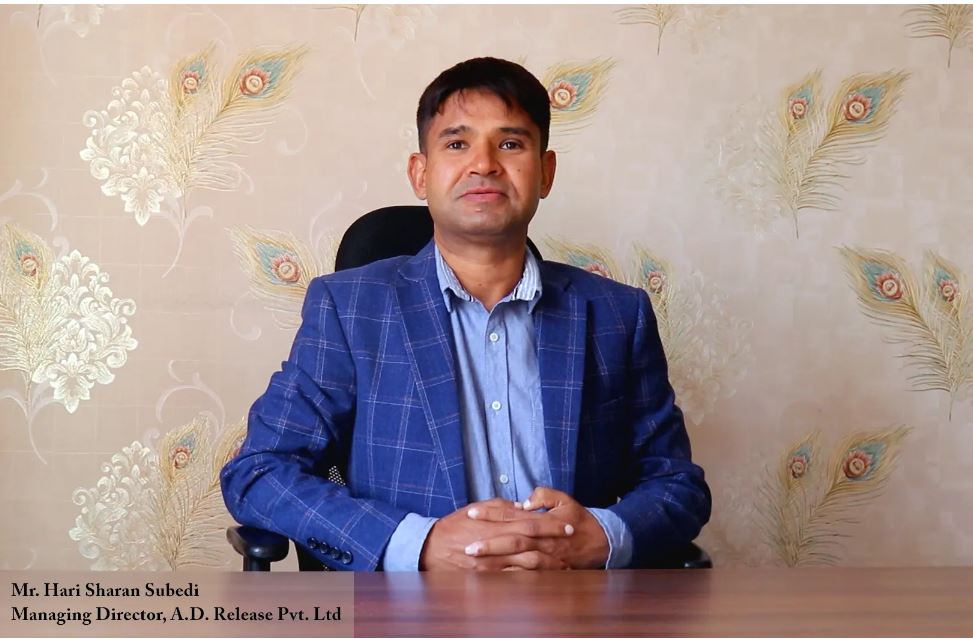
Hari Sharan Subedi: Market saturated with TV stations
Hari Sharan Subedi is the Managing Director of A.D Release, one of Nepal’s leading media buying agencies. With over 20 years of experience in the Nepali media and advertising industry, Subedi has played a pivotal role to introduce pioneering program concepts into the Nepali television industry that include reality TV shows such as Nepal Idol, The Voice and SaReGaMaPa Li’l Champs Nepal along with full production and marketing of the Super Dancer Nepal.
Subedi and his team have also introduced Nepal’s local reality shows such as Comedy Champion and the popular comic series Sakkigoni.
Subedi has been at the forefront of changing the television media sales landscape via innovative advertising segments including on-screen advertising and sponsored segments across news and programs. He is currently the Executive Member of the Advertising Association of Nepal (AAN) and a member of the Information and Communication Technology Development Sub-Committee of the Federation of Nepalese Chambers of Commerce and Industry (FNCCI). The Annapurna Express caught up with Subedi to talk about media buying and the Nepali television industry, Excerpts:
Your agency has consistently been at the forefront of television advertising in Nepal. How would you introduce your business and the industry you are in?
We are a team of think-alike people, and it has been a collective achievement so far. The Nepali television industry has come a long way as the industry grew manifold, thanks to investment in news and programming as well as technology. Today, the television industry employs over 3,000 people, ranging from journalists to production, engineering, administrative and marketing professionals.
The main source of revenue is advertisements. And, the whole advertisement segment has also evolved remarkably in these years. We have seen the whole transition, from VHF tapes to DV tapes and now to transferring audiovisuals digitally across various TV stations from your own office. As a media buying agency, we take pride that we also contributed to this transition positively which helped the overall industry to expand.
Of late, with the growing number of TV channels, there is also the issue of sustainability that is being increasingly discussed within the TV industry. As TV channels fight for advertising revenue that has not grown, do you think these channels will survive?
We have seen flooding of TV stations, from satellite TV stations to regional TVs and those promoted by TV channel distributors in recent times.
Around 200 satellite TV stations have taken licenses, of which over 60 are currently in operation. Even when operated in a very minimalistic manner, the combined operating cost of these channels would be approximately Rs 3 billion. However, the size of the advertising market has fallen post-Covid, and even further due to the current economic slowdown to around Rs 2 billion. How can advertising sustain the television industry in this scenario?
On the other hand, there is a lack of investment in content and broadcast quality. For any TV to have a huge following, one needs to have programs that are attractive, and intriguing for the viewers. Instead, what we see is that most TV stations have the same kind of programming. And, there is also a serious dearth of specialization.
Internationally, sports channels are the most expensive to subscribe to. The world has realized that live sports generate the highest viewership. Unfortunately, we are going one step further in Nepal, killing the exclusivity of TV broadcasts by coupling it with the concurrent digital broadcast.
Reality shows, series, sports, and everything are available on YouTube, and this is the main reason behind the falling TV subscriptions. And to add to this is the Clean Feed debacle. International channels were supposed to be free of advertisement, but we have to see the same irritating promotional spot repeatedly. TV watching has become unpleasant with average content, subscriptions have fallen, and with the economic slowdown, it is natural that advertising revenues have also declined.
What are the pressing issues plaguing the TV industry? Why is the Nepali advertisement market not able to sustain the growing number of TV stations?
Despite the economic slowdown, the number of new media outlets is growing. The situation is such, every advertiser faces a huge dilemma today. While the advertiser’s advertising budget has not grown, they are getting increased follow-up from the media marketers.
Rather than advertising on the media platform that suits their target group, advertisers are literally forced to balance the media, particularly the smaller media outlets that resort to unfair practices. I am personally aware of some larger advertisers forced to distribute ads proportionately across larger to smaller media.
Everyone wants to run a news channel – every TV, every online portal, and every YouTuber. And then there is an absence of television and media rating mechanisms. In India, the TRAI, the government body, rates media by their reach and popularity or following. There is no such mechanism in place in Nepal.
The economic downturn has impacted all businesses across Nepal. But you say that a ‘lack of regulation’ is hurting television media. Are you hinting that there is a lack of regulation across the media sector of Nepal?
Leave a Reply